viernes, 15 de junio de 2012

What is gerontodesign?


Its been a while since the last post, sorry! 
I was finishing the research, now I am ready to bring you the GERONTODESIGN
This first post (post research) its about what is gerontodesign and how design for elders
I hope this information will be useful

What is gerontodesign?

Is the union between the gerontology with the design,the purpose of it is to transform the existent products and systems , projecting them and developing them exclusively for the elders, the goal is to bring to the elders an optimus life quality. Also, the gerontodesign is the conjuction of the emotional and universal design ( that are involve by the sustainability), these designs complete the functional and emotional product development.
The gerontodesign makes use of the anthropometry, ergonomy, and functionality also involves the cultural and social aspects of the person.


Gerontodesign is the universal design + emotional design. Is the Dr.House's cane and the usual black cane...

How could I design for the elders?

The person is the most important aspect, first the person, second the person and third the person. The user is the center of the design. When we have this idea clear as water, we will know that all the info that we’ll found will be cuantitative and cualitative, if we only have one type we are wrong.
In order to obtain the cualitative information we could apply techniques like: deep interviews, observation and ethnography. In the next pages we will be talking about a great technique call “a day in the  person’s life”, this technique requires an special suit.

viernes, 9 de marzo de 2012

One day in the user's life…"La persona"

As a designers we know that we need to know the necessities of the people, but I will tell you : Im not agree with this.

Why?

Because we doesn't only need to know the necessities, we need to comprehend  it , to be emphatic with the user, and start calling him : persona.


I made an experiment…

The Age Lab (MIT) (http://agelab.mit.edu/), BLUM  (http://www.blum.com)and NISSAN (http://jalopnik.com/360954/nissan-engineers-simulate-elderly-experience-with-old-people-suit) already made it too. Its about feeling old, feel like an elder feels. I need to tell you that in 2005 Ron Navarro start to talking about this "experiments", he teach me how to start to think more in the "others", using masking tape in my fingers and trying to open a water bottle.

I recommend to to this experiment, if you need to design for elders, its the best way to understand them, not only physically, but emotional and mental ways too.

Here I exposed the elements that you will need to "feeling"  like an older person:


This suit should work according to vectors, making the exact strength in the right spot to avoid the displacement of the body.


According to AGE LAB:


• The knee and elbow mobility limitations will place, for the simulation of joint stiffness and muscle fatigue increases will slow movement.


• Arms: bands will place connected to the arm and the waist of the person to reduce the mobility of the shoulder joints will be more difficult to reach objects above shoulder height.


• Legs: We will use straps and a harness attached to shoes, to reduce the flexibility of the hamstring, the step is shortened, the leg movements during walking will be shorter and slower.


• The backbone: The accessories of the hull and the band, simulate the compression and rotation of the vertebrae, giving the user a sense of curvature of the spine that occurs with aging.


• Neck: We will use a cervical collar, as it reduces the rotation of the cervical spine and extension, this will cause the entire torso movements to want to rotate.


• Eyes: The use of yellow glasses will be to impair color vision, in addition to them will be difficult to see in dim light.


• Ears: use earplugs to simulate difficulties sharp sounds and tones.


• Balance: The shoes will simulate the changes that occur in our musculoskeletal system in the inner ear, causing imbalance also give us a sense of uncertainty at each step.52


• Hands: The use of gloves and wristbands will be to simulate the reduction in tactile sensitivity, and decreased strength and mobility of the wrist.


Besides these additions, by and based on this research it was decided to add the following:


• In eyes: Different types of lenses to experiment:

✴ Total blindness

✴ Myopia Presbyopia

✴ Halo effect of vision due to retinal problems.


• In the hands thick gloves will be used and if possible be bandaged hand to experience the feeling of a person with advanced arthritis.


• In the torso: is added using a belt to prevent further rotation of the spine will also heat the body, which starts to run out due to pressure and temperature rise, this in order to mimic the usual fatigue in an older age.


*The numer 7 "muñequera" is a wrist bracelet.

Using this suit the designer will know something more about the elder person….. much!!

:)


Some links about gerontodesign

Some of them are in Portuguese or another language, but thanks God, exist: http://translate.google.com

Enjoy it!


Fundaments about Gerontodesign

http://es.scribd.com/doc/72691910/fundamentos-de-gerontodesign#


Age in place


Gerontodesign Method Part 2


We must conquer the truth with conjecture, or we can not conquer


Charles S. Peirce


The research method that encompasses this project is the abductive method,
developed by Charles S. Peirce. The traditional method or deductive and inductivemethod, usually closed to the possibilities of imagination and intuition to get tosomething that could hinder the true user-centered design (which will be discussed in the following pages)

For Peirce there are unconscious processes that the brain takes place to form a hypothesis, it is said that the different elements of a hypothesis are in our mind before we are aware of having made. We clarify that the hypothesis of this research is not aperceptual judgment, but an abductive inference as this was subject to logical analysis.


This method is iterative and goes close observation to meditation or contemplation in a back and forth between the two. Charles S. Peirce tells us that "the sciences havebeen developed separately from the useful arts or the arts that are supposed useful,"with this statement, Peirce is one of the authors indicated (personal judgment) for the development of a design project, because as we know the design has been always in the middle of science and art.


It is said that the abductive method belongs to the processes of imagination and intuition and therefore its validity is rebuttable, but if we go deeper we will know aboutthe abductive method and pragmatism go hand in hand, as Charles S. Peirce is considered one of the fathers of pragmatism. Pragmatism is based on the principle that is true only what works, besides that rejects absolute truths, ideas are tentative and we can say that hypothesis testing will be subject to changes that will underliefuture research.


For all of that we start to thinking that the pragmatism will be something good for the design process, because the people change, the designer change, designing is not about numbers, designing is about people.


As you know, here in Mexico, we are looking forward to create some gerontodesign strategies, that will be posted in this blog. We could say that the hypothesis of our investigation is the conjecture one, the tests are the gerontodesign strategies and the subsequent conjectures are the testing strategies by induction in an iterative process.


The testing of the abductive method will be using the induction process, in which in an empiric way we will put in practice the conjectures or gerontodesign strategies!


:) keep reading!

Gerontodesign Method Part 1


“The important thing is not to stop questioning.” 
-Albert Einstein 


How start to "gerontodesigning"?

Firstable we need to know what type of investigation dominates the research,for this purpose we quot Edgar Morin:

"... we think that there is still a vast field of social science in which there is more than taylorians stages of rationalization of intellectual labor and where full of personalitycan only contribute to scientific rigor. The rigor of reasoning is more important thanthe calculation. The question is more important that the questionnaire ".


Nothing is just black or just white, specially when we talk about a human being, we know that the study of the "persona" its complex, and for this reason we have to start a mix investigation, using qualitative and quantitative data.


The quantitative data will come from all the statistical data and anthropometric data, even from some medical information, socio demographics and economics.

But, how we are going to quantify emotions, attitudes and culture of human beings?


According to Aida Silva, General Manager of Marketing Resources Toschi, qualitative research is done to answer the question "Why?" While quantitative research addresses the questions "How many or how often?" The process of qualitative research is a process of discovery, the process that looks for evidence is the quantitative research.

Qualitative research is used as a mechanism for generation of ideas, can help evaluate a quantitative study. Qualitative research uses in-depth interviews, there is a probability sample such as is interpretative.


As a designers we need, we must know how to do a qualitative research, because we are designing for the people! There are some steps that we need to follow in order to achieve a great investigation result, and mainly valid.


Qualitative sampling


According to Serbia, 2007, the qualitative sampling should not be framed in a classictypology sample because the researcher needs, first, dive into the problem from the field. From a previous theoretical and empirical understanding of the subject and the subject under study, the field will allow you to obtain the conditions for a correctinterpretation of the study (Serbia, 2007).


The qualitative sampling is not about statistics, its about the proximity and familiarity with the person that we want to study.


So, when you start your own gerontodesign or design investigation remember to adjust it to the qualitative sampling, it will lead you to have more "human information" than statistical information, but be careful! the numbers are important to, just think how you will using it.


Qualitative Analysis


"During a round process on the data, the investigator should look for the saturation of speeches about topics of interest to develop descriptions and increasingly abstractgeneralizations from the interpretations of the discourses" (Serbia, 2007).

Are you Thirsty or are you going to be?


Have you heard about "start to dig the well before you are thirsty" ?
Its a mexican phrase, a "refran", that explain us that we don't need to wait to have the problem in front of our nose in order to do something about it….No! We need to start to solve the problem before it comes to our life.


Currently in Mexico there is not a design approach for the elderly, in the world has begun its development, but not its consolidation. Apparently the elders face front to a design objects that usually change their behavior, preventing its development and functioning, yes, its development, some people believe that when we reach the 60 years old the individual development has been completed, but it is not. Is in this process where the designer is involved, using emotional design and user-centered design.


Its in the emotional design where we find the ability to enhance the usability of the product by creating a strong connection between the user and the product (Choi, S., 2006),this type of design is one that is focused on the use of human beings emotions to do more or less pleasant to use an object, also focuses on human intuition, which is why the emotional design will be included in the development of this gerontodesign research.


We live in a world where for several years and now the design profession is seen as the product that is looking for cutting-edge aesthetics, which serve to generate income for large companies and promote the development of personalities and representative figures, this is the side opposite to the social design. We designed for the young man, but little has been thinking about the old man. We may not like to think at that stage, but it exists. And each time more people come to it, note that we talk about ourselves when we are speaking of the future elderly.

jueves, 16 de febrero de 2012

Sustainable design and gerontodesing


As you know the sustainable design is based on the definition of sustainability, we could say that sustainable design is :


A applied thought process  in a strategic manner, transforming existing systems and generates new ones with different characteristics focused on producing the best ecological, economicand social, that support the development of human beings.

So…..

Gerontodesign looks forward to achieve this too.. to generate new systems with better characteristics that make the life more happier and easier to the elders, gerontodesign is based in sustainable design, more specifically in emotional design and inclusive design, two topics that are inside the sustainable design.

Designers like Viktor Papanek and Donald Norman told us the keys to create the gerontodesign strategies that soon will be posted online..

Start thinking about sustainability, and remember it doesn't  only reefers about ecological facts!!

domingo, 12 de febrero de 2012

We'll be old…I hope

Thanks to the medicine, the greats achieves that doctors and researchers have been done, we'll be older than now. It's difficult  to see that fact, but it's true. Not only the designers need to rethink how we design, all humanity needs to rethink their activities and values.

Japanese people respect to much to the elders, and thats so nice! … mexican people ( usually in small's towns ) have the same respect for elders that japanese have to their own. But, what happen in USA? The youngest people seems to have some troubles about being respectful with their grandparents … the media, the trends tend to disrespect the old people. We need to remember that baby boomers where the starters in this ideas, they said that old is boring….and start with all this changes. Now baby boomers are old….

So, gerontodesign is not a salvation to all of our problems, No. The education, the good moral values, the family union and the society are the strongest parts for solving the problems that we will confront in a near future.

Gerontodesign pretends to take this values : the love, the emphatic, the respect, the family union, and so on… We will be old…I hope so, because we will had a second chance to rethink the social values that we have been promoted.

…Rethink!

jueves, 12 de enero de 2012

User Centred Design Part 2: The Principles


  1. Its empirical: Forget about big theories, this design method is about user behavior and user experience. 
  2. It’s iterative: It’s a sociological process in which the research phase is followed by the phase design phase.
  3. It’s participative: The user takes part in the design process, because of that the product needs to adapt to the user, not viceversa. 
  4. It takes into account human diversity: Find the best fit / adjustment for the maximum number of people.
  5. Taking into account that the user task, recognizing that the task is specific to each user. 
  6. It has a systemic approach: the relationship between the user and the product takes place in a social, technical, economic, political and environmental.
  7. It is pragmatic: it recognizes that there may be limits to what really is practical in each case and find the best result within those limits. 


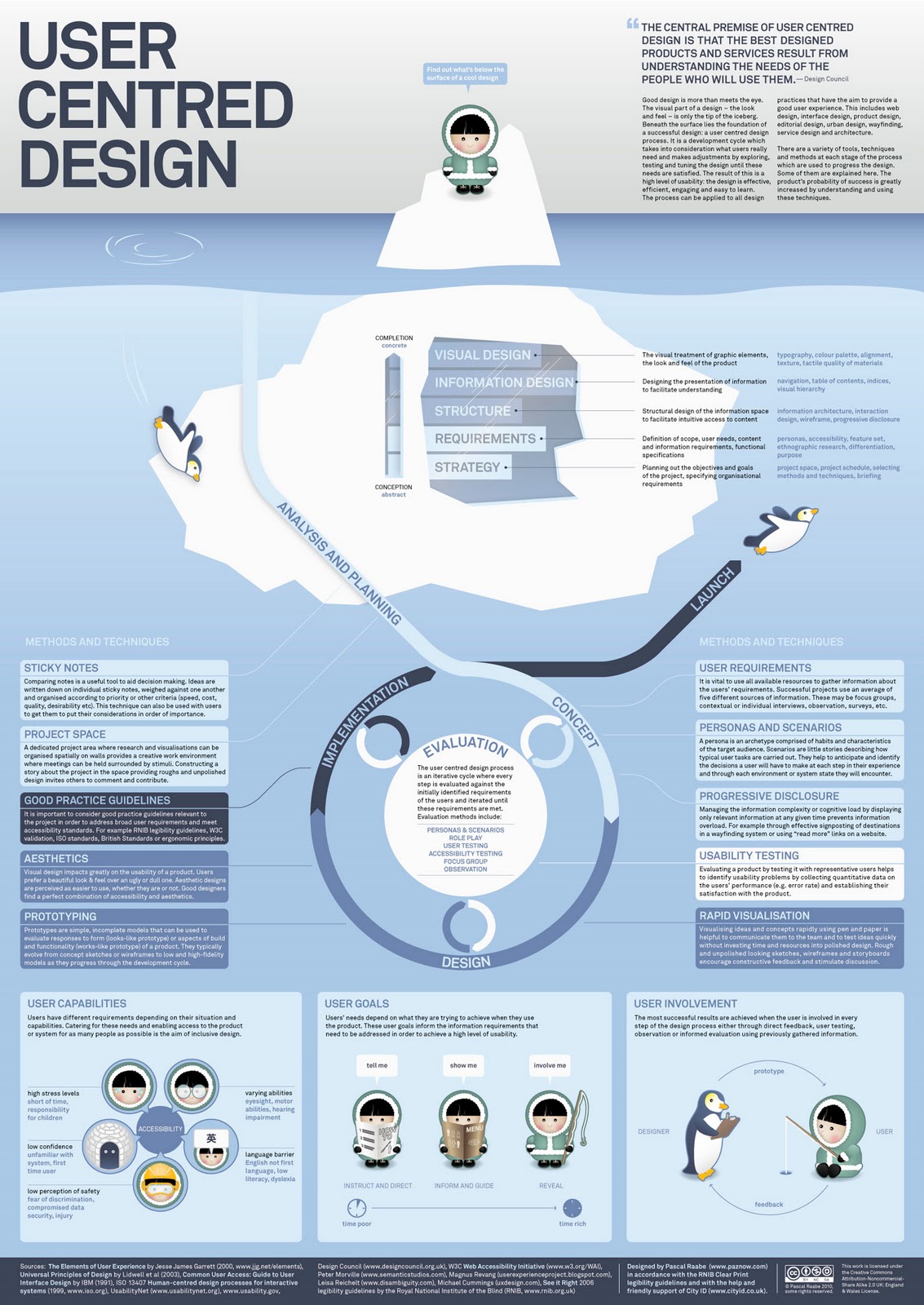
This image from Pascal Raabe explain it:


domingo, 8 de enero de 2012

User Centred Design Part 1


It’s easy to explain what is the UCD is simply: design for the user, thinking, dreaming, sleepping, and again thinking about and with the user. All starts by saying that the user is a person, a human, a unique human being with a culture and traditions.


In order to applies this method we need to:

1.Specify the context of use of the system or product that we want to design.
2.Specify the requirements
3.Create design solutions
4.Make a design evaluation


The user centred design has some bennefits like:

Start a true relationship between the people and the products

It’s a persuasive tool that is used to communicate what you want

Allow us to observe the user behavior


O’ Brien (2006) said us that Stephen Pheasant (Royal Free Hospital of London, Ergonomist) was the person that develop the UCD principles.


In the next post we well talk about this UCD principles....

sábado, 7 de enero de 2012

The Gerontodesign Process


As we said at the beginning of this blog, gerontodesign is defined by Joaquim Parra as the agglutination of the gerontology and the design, but we think : What design?


---What are the features of this design that is agglutinated with this socio anthropological science? ---


There are to many design methods, but one of them call our attention, this method is the UCD or User Centred Design, is kind of funny or may be its the destiny that this design method make use of ethnography research and gerontology uses too.


The UCD helps the designers to understand how people uses and don’t uses the products, this results in reducing the impact of use (Lofthouse V. & T. Bhamra, 2007).


Also in this design process we make use of an anthropological technique called monographs, this technique was developed bythe French sociologist Federico Le Play.


The gerontodesign process is composed by design methods and anthropological techniques all this is implemented using the following technologies: videocamera, cellphones, camera, Aging Suit and Computers systems.

domingo, 1 de enero de 2012

Mexican Elders and their needs

For this design research we focus on mexicans elders and their needs in order to create some design strategies, firstable we start to search everything about  tthe main diseases that mexicans people presents, the SABE 2001 tell us that there are a relation between the diseases and the disabilities. 

SABE 2001


Hight Blood Pressure or Hypertension is one of this patologies that evoque the generation of some kind of disabilitie.


The ENSAEM 2001 ( National Survey of Aging in Mexico) show us that

12.2 of 100 persons that live in the country have problems to prepare their meals also this problem is presente in the life of 9 of 100 persons that live in the city.


There are a lot of activities that a human does, because of that the experts have been divided this activities in Intrumental activities and Daily life activities.


Instrumental Activities:


To prepare meals

Shopping

To take their medicine

To handling money


Daily Life Activities


To walk

Take a Shower

To eat

Go to the bed


As an observers we can see that there are to many products focus on walking and bathing activities, sadly this products are to expensive and inaccessible for the most of the mexican population, so do are some architectural proyects.


There are to many products that are focused on helping the elderly to prepare their meals, some of this products are presented right here:


Mixers


Maybe this examples are gerontodesign products, maybe…. but there is a little fact call emotional design that in some of them is missing….maybe


viernes, 9 de diciembre de 2011

Why a designer must learn something about...

GERONTODESING

There are simple reasons for learn something about gerontodesing, not only for being designers, simply because we are humans and we are getting old as a nation, as a world…

Gerontodesign is about be emphatic with the "others" , talking about "the others" we need to think who are they, what does they like?…and really who are "the others"? are we?.

As a humans we need to become more emphatic with the life that occurs in our society. In the 80's and 90's we star to see more the disrespect that young people demonstrate to elders, also David Cravit in his book called "The New Old" talks about what's happening to the baby boomers, people who start the revolution against old, and now they are old.

So, we need to learn about gerontodesing, because we need to be emphatic humans and emphatic designers, using techniques like the user centered design or ethnography we will know more about elders, about the persona and these lead us to be better designers.

It's a fact . World is getting old, and we need more and new  products to solve new needs.

jueves, 8 de diciembre de 2011

Demographics in Gerontodesign - Latin America- Mexico

2030 : 1 of 6 persons will be over 60 years old (LARNA, 2010).

SABE 2001
Mexico City: 13% of people over 70 years old live alone and 24% with somebody else (Archundia,2010).


So, maybe Latin America isn't getting older, fast as Europe or Asia, but the fact is that is getting older, maybe slowly, but it is happening! …Gerontodesing must start to be tough

Demographics in Gerontodesign

There's no need to write to much about this topic : Demographics…., why? because the images that we'll show you in this post will tell you all.

The world is getting old.


Taken from 2nd LARNA
From ONU 2011

Taken from 2nd LARNA


We know that Japan is the oldest country in the world and also Germany, Italy, Spain are olds countries, also we know that Countries like Qatar are young, Mexico is now with the middle age of 26, but in a few decades will be old too. Is easy to think that what happens in Japan doesn't concern to the others countries, but common'! we live in a globalized world in which what we do in Mexico affects in China… and vice-versa.


lunes, 5 de diciembre de 2011

Why Gerontodesign?

When you live with people that are more than 70 years old you start to think about their needs, when you see that all the things that could help the elders are located in medical stores you start to think that maybe this is not good…


The products for elders usually located at medical stores are lacking of emotional design. It's difficult to understand why people think that elders are people with a disease, because old people aren't sick people.


85% of the information that we received comes from the eyes and 10% by the sense of hearing, almost every activity and mobility are realized by combining those senses, this information lead us to think what happen when we reach the 75 years old and our sense of hearing and seeing are decreased?


It's necessary to start to thinking about gerontodesign because after the 60 years old, the people start to lose their physical abilities. We have been saying that disabled people are not elders and elders are not disabled people, maybe sometimes elders are disabled and disables are elders, but not always… Is because of that, that gerontodesign must be created and started.


Caroline Günther -Luckow, Dipl.-Ing. Architect,M.Sc (2011) tell us her opinion about this topic in this way: 


"In my opinion it is essential to develop new housing concepts for the elderly as our present situation is not up to date. The aging population is growing older in a different way. Expectations towards life as well as the standard of life have changed. In Europe the population is getting older. The reasons are a very much improved health care, better financial situation and the personal aim to stay in form longer. Generally I believe we need to consider the emotional aspect far more and integrate this into our planning routine."


In the next post we will talking about demographics reasons….

:)

viernes, 2 de diciembre de 2011

Gerontotechnology

Jan Graafmans (1989) at the University of Technology (Eindhoven, Europe) defined the term "Gerontotechnology" as the study of technology and aging in order to improve the daily life functions in the old people, Lawton (1998) defined it like this: is the adaptation and products, services and environments development to the needs of a aging population.

Ávila Alva (2010) talks about an analysis of the vision of Lawton in applications of gerontotechlogy:

1. For improve functions decreased.
2.Compensate for lost functions.
3. Prevent illness associate with aging.
4.Support elder care.
5.Promote aging research.

Gerontotechnology and Gerontodesign are similar in some kind of way, but we need to remember that design has 3 spheres that composed it, there are:

1. Function
2. Technology
3. Aesthetics

Maybe the term gerontotechnology stays in a limit and gerontodesign goes further, also a difference between gerontodesing and gerontotechlogy is the word "adapt"… the Gerontodesign looks for design/ create no to adapt things. When we say "adapt" we are creating at the same time a barrier or a stigmatization in the product, is maybe the same that occurs when we "adapt" things for disabled people…

As humans we want to be recognized like an valuable entity and if we think how we will feel using products that were designed for somebody else and have this --adaptation-- to us, then we'll know what's the feeling in a daily life of a disabled people; because the functional need is solved but what happen to the emotional need? is already solved too?

I'm not saying that gerontotechnology is "bad", no! Gerontotechnology is a very important part of gerontodesign, also in the internet there are information about this:

http://www.gerontechnology.info/

http://gerontechnology.net/

http://www.redenvejecimiento.com/index.php/en/researching-aims/gerontechnology

http://books.google.com.mx/books?hl=es&lr=&id=uv1BEgOz5pgC&oi=fnd&pg=PR5&dq=gerontechnology&ots=XNPKrF3fu-&sig=rDkeOvIaXNSFqOCR6XgqZFLcjv0#v=onepage&q&f=false


Examples of Gerontodesign

We have been saying that the design for elders is really beginning, but this doesn't mean that it doesn't exist, may be the gerontodesign that we want (with the base of emotional design) does not have been design or created yet….

We put some examples here, that are the first products for elders, we need to repeat that elders are not sick people, an elder person can be a disabled person, but a disabled person is not always an elder.

Some gerontodesign products…but some of them are lacking of emotional design
 
This stove was designed in Japan, as we know Japan is the oldest country in the world right now!

Gerontodesign Background

The concept is very new, but also has a lot of background history, in this post we show you some


TOPIC
WHOS
WHAT
REFERENCE
Gerontodesign
Dr. Joaquim Parra Marujo
(2006)
Concept 
Gerontodesign
Calçado Bemicar
(2007)
Elders shoes
Gerontodesign
Fisk,A;Rogers,W.;Charness,N.;Czaja, S.; Sharit, J.(2004)
Design for elders guide, gerontotechnology
Fisk,A;Rogers,W.;Charness,N.;Czaja, S.; Sharit, J.(2004)
Designing for older adults
New York, EUA
Taylor & Francis Group

Social Design
Victor Papanek
(1984)
“Design for the real World” 

Design for the real world, human ecology and social change
Victor Papanek
1984

Universal Design
 Fundación ONCE en España
(2006)
White book of design for all


Inclusive design
Marvin Lara 
(2008)
Universidad de Carleton, design for people who have arthritis
Carleton University School of Industrial Design IDES 4001 
Inclusive design
Morenos Ramos D, y Corregidor Sánchez AI
(2010)
Urban design for elders

Medical Design and some gerontodesign
Parsons ADL
Products
Gerontodesign
Arizona University , EUA
Elders stove design
Gerontodesign
Charles y Hudson
Kitchen's for elders
Social Design
Andrew Wootton, Universidad deSalford
(2006)
Business and responsability
Sustainable design and user's behavior 
Dr.Debra Lilley / Dr.Vicky Lofthouse
(2007)
How design can influence the user's behavior
Gerontodesign
Fundación Helen Hamlyn
En el Royal College of Art
(1991)
The program had the goal of make conscience about design for elderly population
Gerontodesign
Joseph Coughlin y el MIT de Massachusetts 
(1999 - a la fecha)
Multidisciplinary group that is focus on how you and me will live tomorrow
Gerontodesign
OMS 
(2005)
Age Friendly Cities 
Gerontotechnology
Instituto de Geriatría México (2010)
Focus in the analysis, design and implementation of solutions that are based on technology applications oriented to solve or prevent problems
that are related to aging process
Perspectivas para el desarrollo de la investigación sobre el envejecimiento y la gerontecnología en México
Memorias del Encuentro Nacional sobre Envejecimiento y Salud
Agosto 2010
Universal Design
International Design Center in Berlin
Elders design
Inclusive Design
IDeA Center, Center for Inclusive Design and Environmental Access, Buffalo, USA
Elders design
Inclusive Design
NC State University, Center for Universal Design
Elders design

jueves, 1 de diciembre de 2011

What is not gerontodesign?

When we see an elder person whit a cane or in a wheel chair we used to think that the person is using the products for the elders, we used to get confused about medical design and gerontodesign.

Medical design can be used by everybody, a child or a pregnant woman, an adult or a teen ager could be the users of one medical design product.

The example that I love to used for the explain this idea is Dr. House.
Why Dr. House?


The cane that House use to walk is a symbol that he distorts into another new one, a cane is a medical design object that represents some kind of pain and disability, also a cane represents power, represents respect (Do you remember Moises or Noe?) so, the cane is a symbol of aging and House doesn't want to be old, so he distorts the cane, he converts it into a symbol that maybe makes him more interesting or sexier (for some women), so he turns the cane's symbols into another's one's…

Gerontodesign is in some kind of way the Dr. House cane's, is resolve the necessities of elders in a different way, because the elders are different now, and even if we talk about a 90 years old person, we are not talking about a boring or sad person, so may be the cane with flames will be ok…:) 

what do you think?